
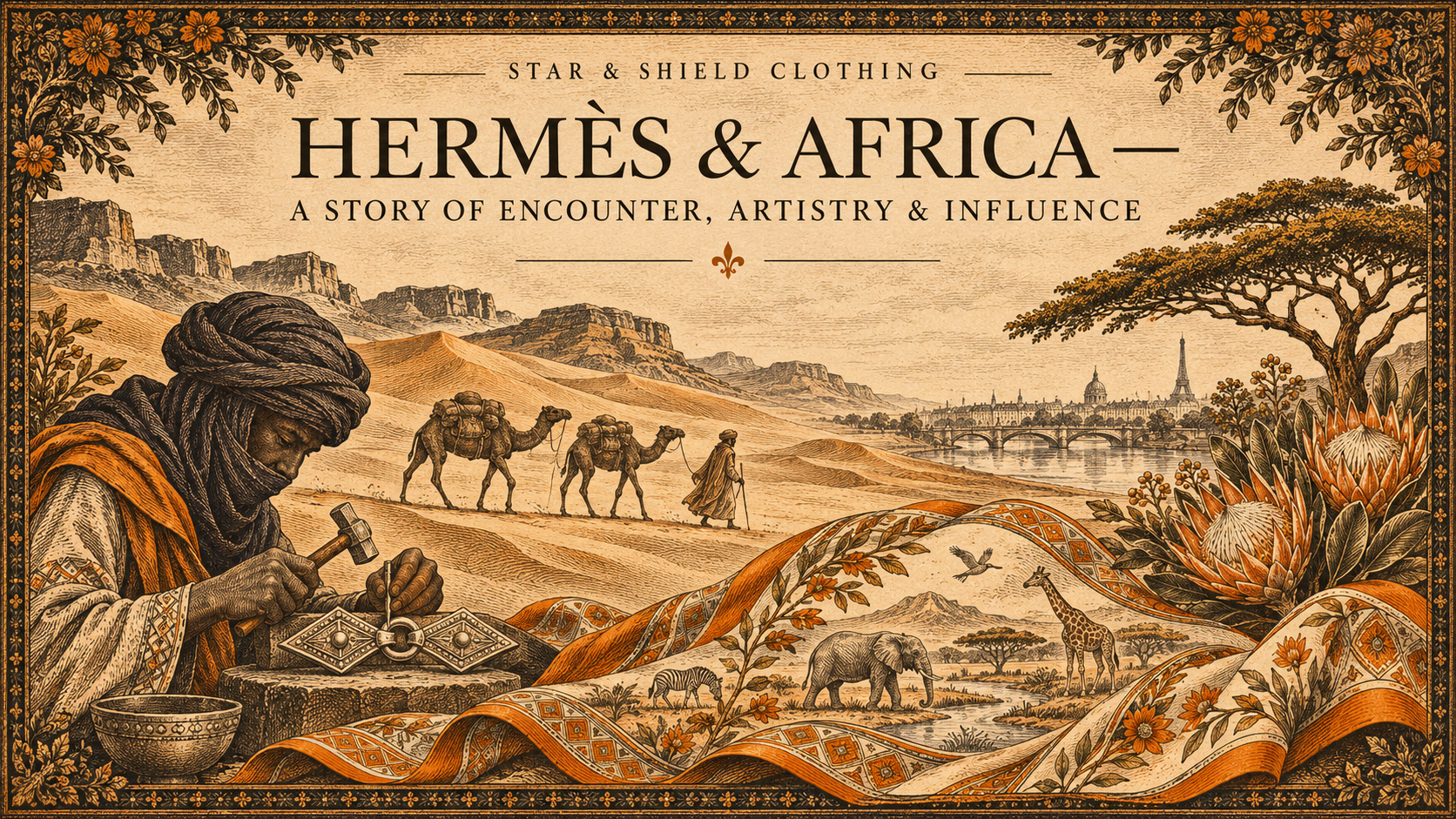
Craft • Culture • Exchange
Hermès
& Africa
Paris • Niger • South Africa
Tracing the documented connections
Hermès began in Paris in 1837 as a harness workshop. Its later design history includes encounters with African artists and visual traditions—but the record is specific, not sweeping. Two modern examples stand out: Tuareg silverwork from Niger appearing as scarf motifs, and a collaboration with South Africa’s Ardmore art collective.
This feature follows those documented moments while recognizing the makers and communities behind them. It does not suggest that African influence explains every Hermès design, or that the Paris house represents African craft.
Thierry Hermès opens a harness-making workshop in Paris, establishing the house’s equestrian beginnings.
A Tuareg silver guild is formed in Agadez, Niger. Smithsonian reporting later describes how Tuareg clasps and necklaces reached Hermès scarf motifs.
Hermès presents scarf designs by Sydney Nyabeze, made in collaboration with Ardmore, the KwaZulu-Natal collective founded by Fée Halsted.
Hermès women’s spring–summer 2027
Official Hermès runway film, presented October 3, 2026. If the player is unavailable in your region, watch the show on YouTube.
Three ways a motif can travel
These small, original visual studies interpret the documented stories below. They are not Hermès products, archival reproductions or official designs.
01 / The clasp
A new geometric composition referencing the graphic forms of Tuareg silverwork. The specific historic reference is Smithsonian-reported scarf motifs inspired by Tuareg clasps and necklaces.
02 / The river
A fresh scarf composition with a river border and wildlife silhouette, in conversation with La Marche du Zambèze, one of the 2016 Ardmore-associated designs.
03 / The bloom
A botanical pattern study pairing a protea-like bloom and animal markings. It nods to Ardmore’s exuberant flora-and-fauna vocabulary without copying any specific artwork.
Specific links, clearly named
The Smithsonian’s 2007 account connects Tuareg silver guild work in Agadez to clasp and necklace motifs appearing on Hermès silk scarves. Fashion reporting on the 2016 release identifies the Ardmore collaboration, the designs La Marche du Zambèze and The Savana Dance, and artist Sydney Nyabeze.
Hermes and Thoth in Egypt
In Hellenistic Egypt, Greek Hermes was associated with Egyptian Thoth; the resulting figure, Hermes Trismegistus, belongs to the history of religion and philosophy. This ancient cultural fusion is distinct from the modern French fashion house and should not be treated as evidence of its direct design lineage.
Leave a Reply