By Star and Shield Clothing — Ethical Luxury Blog
There are moments when fashion, music and intellectual property collide so perfectly that the resulting controversy becomes bigger than a sneaker release. Nike’s 2026 “Dreams & Nightmares” LeBron 23 collection is one of those moments.
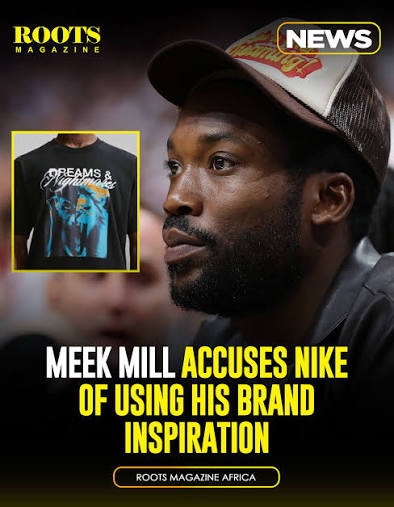
In May 2026, Philadelphia rapper Meek Mill publicly challenged Nike over a new LeBron James sneaker and accompanying apparel carrying the “Dreams & Nightmares” name. For Mill, the phrase is inseparable from his artistic identity: it is the title of his 2012 debut studio album and its defining opening track. The song has subsequently become part of the wider vocabulary of sports motivation and perseverance. (VICE)
But there is an important distinction to make at the outset: as of August 13, 2026, the public reporting reviewed for this article does not establish that Meek Mill has filed a copyright lawsuit against Nike. What exists is a very public intellectual-property dispute, a pending trademark application, allegations of visual and branding appropriation, and an unresolved question about where artistic influence ends and commercial ownership begins.
For an ethical luxury audience, that distinction matters.
Because the real story is not simply whether Nike “copied” Meek Mill. It is about who gets to control cultural meaning once an artistic expression becomes commercially powerful — and whether major fashion companies have a responsibility to engage with the creators whose cultural language they use.
The controversy began with a LeBron 23
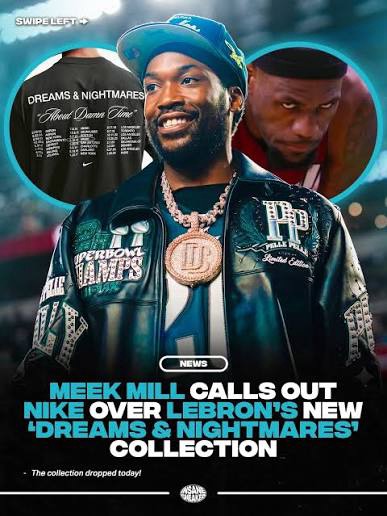
Nike’s “Dreams & Nightmares” LeBron 23 was released on May 26, 2026, with a reported retail price of $235. Nike positioned the shoe around LeBron James’ journey from criticism and pressure to his first NBA championship with the Miami Heat in 2012. (Black America Web)
The choice of words immediately caught Meek Mill’s attention.
On X, he questioned why Nike had apparently used a concept so closely associated with his work without contacting him. His complaint was not limited to the words themselves. He argued that Nike had taken his broader “brand” and combined it with LeBron James.
That distinction is important.
“Dreams and Nightmares” is an ordinary phrase in the English language. Neither Meek Mill nor anyone else can simply claim ownership over the concept of dreams and nightmares. The legal question becomes much more complicated when those words are used as a commercial identifier in a particular market, alongside artwork, imagery, typography, music or other elements that may create an association with a particular creator.
And that is where the story becomes much more interesting.
From a song title to a cultural identity
Meek Mill released Dreams and Nightmares in 2012. Over the years, its opening track moved beyond the boundaries of hip-hop.
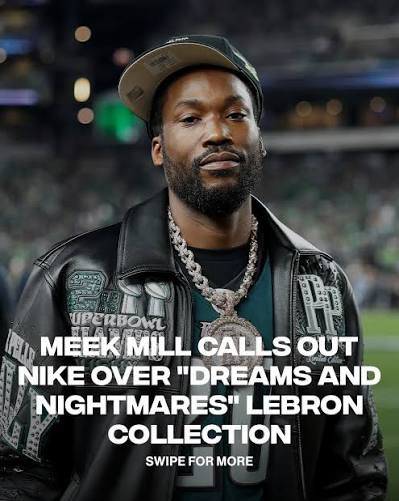
Its themes of struggle, ambition and eventual success made it particularly attractive to sporting culture. The song became associated with major sporting moments, including the Philadelphia Eagles’ 2018 Super Bowl run. Reports at the time noted a huge increase in streams following Philadelphia’s championship victory. (AllHipHop)
That evolution is central to understanding Meek’s objection.
A song can begin as a copyrighted musical work. But its title, lyrics, imagery and cultural associations can develop commercial significance beyond the recording itself.
The phrase “Dreams & Nightmares” may be linguistically generic. Yet within popular culture, it can also immediately evoke Meek Mill’s music for millions of consumers.
That is the tension at the centre of the Nike dispute.
Copyright is not the same thing as trademark
Much of the online discussion has described the situation as a “copyright case.” Legally, that terminology needs some caution.
Copyright and trademark protect different things.
Copyright generally protects original creative expression — such as musical compositions, sound recordings, artwork and other eligible creative works.
Trademark law, by contrast, is principally concerned with identifiers used in commerce: names, logos, phrases and other marks that tell consumers where goods or services come from.
That means Meek Mill’s ownership of the copyright in a song does not automatically give him exclusive rights to every commercial use of the song’s title.
A song title can also face copyright limitations because short titles and phrases generally do not receive the same copyright protection as an original creative work such as the song itself.
The potentially more relevant question here is trademark and related unfair-competition principles: does “Dreams & Nightmares,” in the context in which Nike used it, function as a brand identifier associated with Meek Mill, and could Nike’s use create confusion or improperly trade on that commercial association?
That is a much harder question.
Meek’s 2026 trademark filing changes the conversation
One of the most significant facts to emerge from the controversy is that Dream Chaser Records, Inc. filed a federal trademark application for “DREAMS AND NIGHTMARES” on May 18, 2026 — just eight days before the Nike release and Meek Mill’s public complaint. (Justia Trademarks)
The application is important because it covers multiple categories of goods and services.
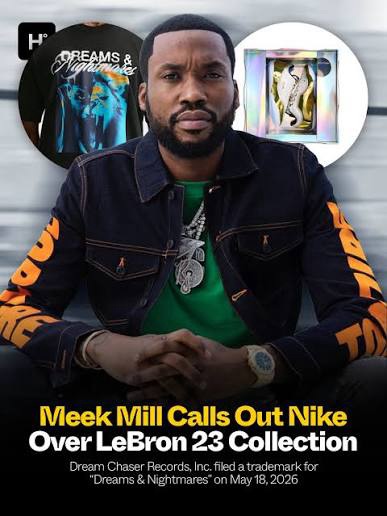
The application with serial number 99831235 includes musical recordings and entertainment-related services, as well as clothing including T-shirts, hoodies, headwear and outerwear. The filing records first use dates going back to 2012 for certain goods and services. (Justia Trademarks)
A separate application filed the same day, serial number 99831039, covers additional merchandise categories, including footwear, bags, jewelry and related goods. (Trademarkia)
However, these are applications, not registrations.
That distinction is critical.
The available trademark records show the “Dreams and Nightmares” applications as new filings that had not yet been assigned to an examining attorney in the records reviewed. (Justia Trademarks)
So it would be inaccurate to say that Meek Mill simply “owns the trademark” because of the May filing.
The legal situation is more nuanced.
The timing raises questions
The timing of the application has inevitably attracted attention.
The Dreams and Nightmares album and song date back to 2012. The new federal application, however, was filed in May 2026.
That does not necessarily mean Meek Mill had no trademark rights before the application. In U.S. trademark law, rights can arise through use in commerce rather than registration alone. Registration, however, can provide significant procedural and substantive advantages.
The application itself claims first use dating to 2012 for relevant goods and services, which suggests that Dream Chaser Records is asserting a much longer commercial history than the filing date alone might imply. (Justia Trademarks)
This is precisely why a trademark dispute cannot be reduced to the statement: “He only trademarked it after Nike used it.”
The actual questions would include what was used, by whom, in what commercial context, how consistently it was used, whether consumers associated the mark with a particular source, and whether competing uses were likely to cause confusion.
Then there is the artwork
The strongest part of the public argument may not be the words at all.
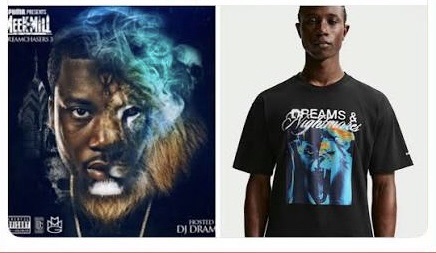
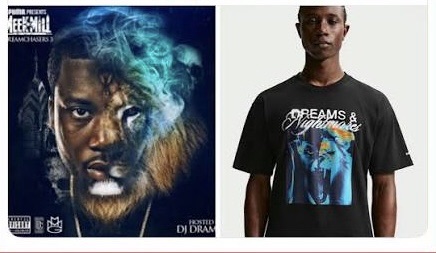
Images circulating from the Nike apparel collection prompted comparisons with artwork associated with Meek Mill’s Dreamchasers 3 mixtape. The Nike shirt reportedly features LeBron James combined with lion imagery, while the Dreamchasers 3 artwork also uses a split human-and-lion concept. (Black America Web)
This matters because visual artwork can potentially receive copyright protection independently of a title or slogan.
A phrase such as “Dreams & Nightmares” might be difficult to protect through copyright. An original illustration, however, can be a completely different legal proposition.
That does not mean that visual similarity automatically equals copyright infringement.
Copyright infringement analysis generally asks whether the allegedly infringing work actually copied protected expression, rather than merely sharing an idea, theme or general concept.
“Person combined with a lion” is an idea or visual concept at a relatively high level of abstraction. The specific execution — composition, proportions, drawing style, arrangement, details and other expressive elements — can potentially be protected.
The closer the expressive details are, the more significant the comparison becomes.
The ethical question is bigger than the legal one
This is where Star and Shield Clothing’s ethical-luxury perspective becomes particularly relevant.
Fashion has always borrowed from music.
Music has always influenced fashion.
Sneaker culture has been shaped by athletes, rappers, designers and subcultures whose creativity often existed long before major corporations monetised it.
That exchange can be positive. Collaboration between artists and fashion companies can produce some of the most culturally significant products in contemporary fashion.
But collaboration works best when the creator is recognised, compensated and given meaningful agency.
The question raised by the Nike-Meek Mill controversy is therefore not simply:
“Did Nike break the law?”
It is also:
“When a corporation commercially uses a phrase or visual language that has become strongly associated with an individual creator, what is the ethical responsibility to engage that creator?”
Those are different questions.
A company can potentially have the legal right to do something and still make a questionable ethical decision.
That is particularly relevant to luxury.
Ethical luxury cannot stop at materials
When consumers hear “ethical fashion,” the conversation often focuses on familiar subjects: sustainable materials, supply chains, worker conditions, carbon emissions, animal welfare and manufacturing transparency.
All of those issues matter.
But ethical luxury also requires thinking about intellectual labour.
An artist’s identity is an asset.
A songwriter’s catalogue is an asset.
A designer’s visual language is an asset.
A community’s cultural vocabulary can become an asset.
If luxury is fundamentally about value, then ethical luxury has to ask how that value is created — and who receives it.
The fashion industry has repeatedly demonstrated an appetite for cultural references. Hip-hop, streetwear, skateboarding, sports and youth culture have all provided enormous creative and commercial value to luxury and mass-market fashion.
The ethical question is whether the people who generated that cultural value are treated as partners or simply as sources of inspiration.
Nike’s side of the story matters too
There is another important principle: an accusation is not a finding.
Meek Mill has publicly objected to the collection. That does not establish that Nike infringed his intellectual-property rights.
The available reporting reviewed for this article also does not establish a judicial finding against Nike or a final settlement resolving the dispute.
Nike’s stated concept for the collection was connected to LeBron James’ journey toward his first NBA championship. The “dreams and nightmares” framing can therefore be understood independently as a story about sporting ambition, pressure, failure and achievement. (Complex)
In other words, there are at least two cultural narratives operating simultaneously.
For Nike and LeBron, the phrase can describe the athlete’s journey.
For Meek Mill, it represents a defining piece of his artistic catalogue and public identity.
Those meanings can coexist.
The difficult question is what happens when they are placed on the same commercial product.
Could the visual similarities become legally important?
Potentially — but evidence would matter.
If an artist believed a copyrighted artwork had been copied, the analysis would focus on protected expression and substantial similarity, among other issues.
If the claim concerned trademark rights, the analysis would be different. Courts could consider factors such as the strength of the mark, similarity of the marks, similarity of the goods, evidence of actual confusion, intent and the overall marketplace context.
And if the argument were that Nike was deliberately evoking Meek Mill’s identity without authorisation, questions about consumer association and commercial intent could become especially significant.
None of this means Meek has automatically established a legal case.
It means that the controversy contains several different intellectual-property questions that should not be collapsed into one word: “copyright.”
The power of cultural association
Perhaps the most fascinating element of this dispute is that Meek Mill’s strongest asset may not be a registration certificate.
It may be cultural association.
For more than a decade, “Dreams and Nightmares” has been attached to Meek Mill’s public identity. The phrase is associated with his debut album, one of his most famous songs and a narrative of struggle turning into achievement.
Nike did not invent the English phrase.
But brands do not operate only in dictionaries.
They operate in culture.
And culture assigns meaning.
A word can be generic in the abstract while carrying an enormous commercial association in a particular context.
That is why brands spend billions creating associations between words, images and identities.
It is also why cultural ownership disputes are becoming increasingly important.
The fashion industry’s bigger lesson
The Nike-Meek Mill controversy offers a useful lesson for every fashion company — from global sportswear corporations to independent luxury labels.
Legal clearance should be the beginning of cultural due diligence, not the end of it.
Before using a phrase, image or concept, a responsible brand should ask:
Who made this famous?
Who has built a commercial identity around it?
Could consumers reasonably associate this campaign with an existing creator?
Is the reference respectful?
Could the creator be involved?
Could a licence or collaboration create a better product?
Would compensation or attribution be appropriate?
Those questions are not merely legal precautions.
They can be good creative practice.
A genuine collaboration with Meek Mill, for example, could potentially have transformed a controversy into a cultural event. Instead of asking whether Nike had to contact him, the more interesting ethical question is why a brand would not want to.
When the cultural connection is obvious, collaboration can create value for everyone.
The luxury lesson: provenance applies to ideas too
Luxury fashion has long celebrated provenance.
Consumers want to know where a leather was sourced, who made a garment, which atelier produced it and what craftsmanship went into the finished object.
Why should intellectual provenance be treated differently?
If an aesthetic comes from a particular artist, community or movement, that history is part of the object’s story.
Ethical luxury should therefore recognise provenance of ideas.
That does not mean every phrase or cultural reference must be licensed.
It does mean brands should be honest about where their creative language comes from.
There is a difference between inspiration and extraction.
Inspiration acknowledges.
Extraction takes.
Collaboration shares value.
Appropriation concentrates it.
The line between those concepts is sometimes difficult to define legally, but consumers are increasingly capable of recognising the difference ethically.
What happens next?
As of August 13, 2026, the most responsible description of the situation is that Meek Mill has publicly challenged Nike over its “Dreams & Nightmares” LeBron 23 collection, while Dream Chaser Records has filed federal trademark applications covering the phrase across entertainment and merchandise categories. The applications remain distinct from a completed trademark registration, and the reporting reviewed does not establish a final court judgment or confirmed copyright lawsuit against Nike. (Justia Trademarks)
That leaves several possible paths.
The parties could simply move on.
They could negotiate privately.
Dream Chaser Records could pursue trademark-related objections or other legal remedies.
The dispute could eventually become formal litigation.
Or, perhaps most constructively, Nike and Meek Mill could find a commercial solution that acknowledges the cultural overlap and turns a disagreement into a collaboration.
For the fashion industry, the last option may be the most interesting.
A dream worth protecting
There is an irony at the centre of the entire story.
“Dreams and Nightmares” is fundamentally about ambition — about imagining a better future while remembering the obstacles that stand between the dreamer and that future.
That message belongs to Meek Mill’s artistic legacy.
It can also describe LeBron James’ sporting journey.
And it can describe fashion itself: an industry built on turning imagination into objects that people can wear.
The question is not whether one person owns the idea of dreaming.
They don’t.
The question is whether commercial power should be used responsibly when a dream has become part of another creator’s identity.
For Star and Shield Clothing, that is where ethical luxury begins.
Not with the question, “Can we use it?”
But with the more demanding question:
“Who helped make it valuable — and are we treating them fairly?”
That is a standard worth applying not only to Nike, but to every fashion house, streetwear label, luxury brand and creative business operating in today’s increasingly interconnected cultural economy.
Because the future of ethical fashion will not be judged solely by what our clothes are made from.
It will also be judged by whose creativity we value, whose stories we tell, and who gets to share in the value those stories create.