
By Panafrican.email | Music & Culture
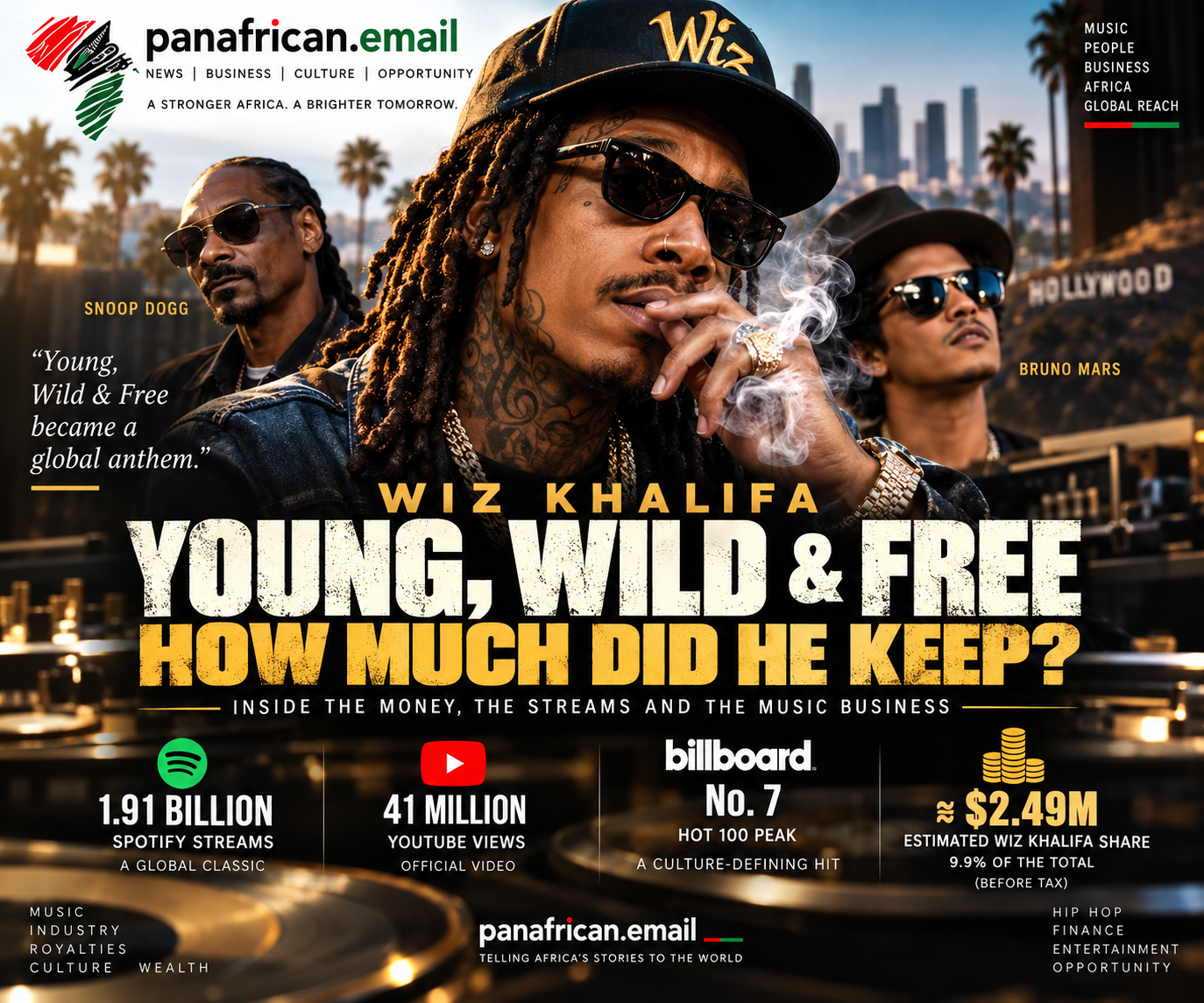
A decade and a half after its release, “Young, Wild & Free” remains one of the most recognizable collaborations in contemporary hip-hop. The 2011 single brought together Wiz Khalifa, Snoop Dogg and Bruno Mars, combining a laid-back rap record with a highly accessible pop chorus.
Now, an analysis published by MusicLedgerHQ is putting a new question in the spotlight: after the money generated by the song is divided among labels, featured artists, producers, publishers and administrators, how much might Wiz Khalifa actually have retained?
The answer presented by MusicLedgerHQ is approximately $2.49 million before tax.
But there is an important qualification: that figure is an estimate, not an official accounting of Wiz Khalifa’s earnings. MusicLedgerHQ itself states that its numbers are estimates and commentary rather than official figures.
A billion-stream catalog asset
“Young, Wild & Free” was released on October 11, 2011, as the lead single from the Mac & Devin Go to High School soundtrack. The track was performed by Snoop Dogg and Wiz Khalifa, with Bruno Mars providing vocals. Atlantic Records and Rostrum were involved in its release. (Wikipedia)
The song became a major commercial success, reaching No. 7 on the Billboard Hot 100 and later earning a multi-platinum certification. A historical royalty-market listing described the song as a significant generator of public-performance royalty income within a catalog that included the track. (Royalty Exchange)
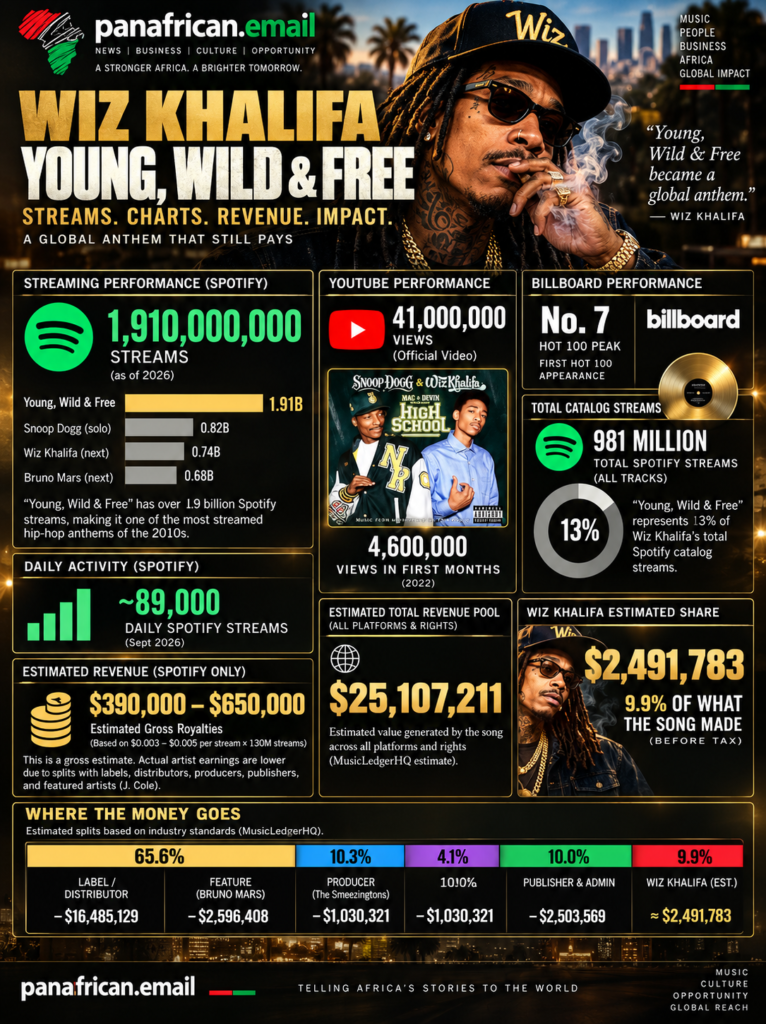
Streaming has extended the commercial life of the record far beyond its original release period. A Spotify listing indexed recently shows the song with more than 1.88 billion streams, although the exact figure varies depending on the specific Spotify release/version being displayed. (Spotify)
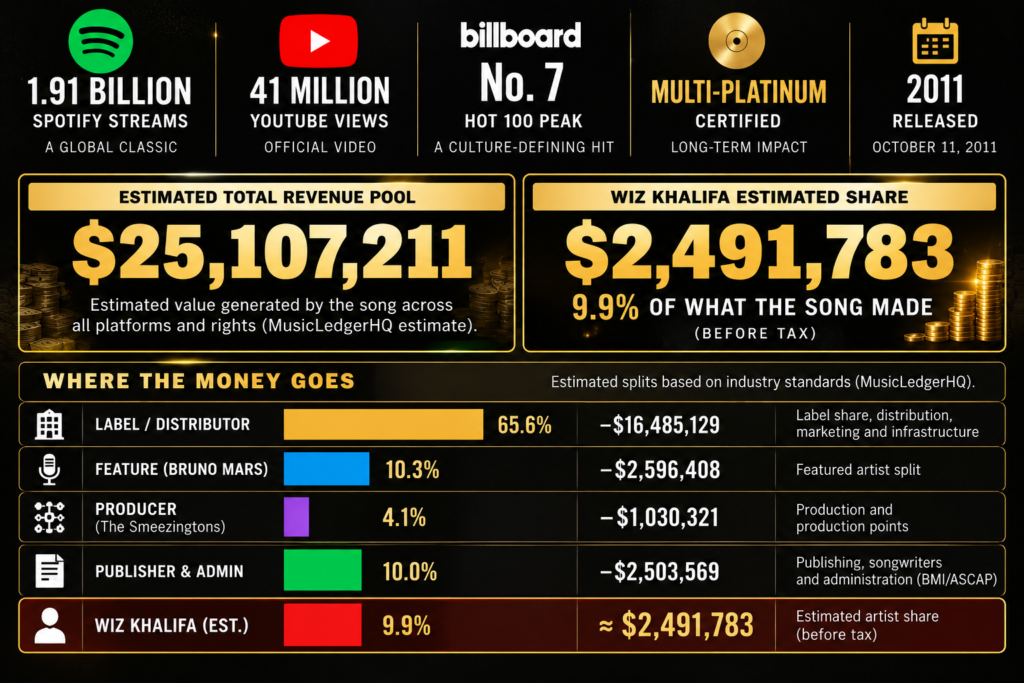
MusicLedgerHQ’s carousel uses a figure of 1,907,118,170 Spotify plays in its analysis.
That enormous audience is the starting point for its financial estimate.
The $25.1 million “pot”
According to the MusicLedgerHQ analysis shown in the carousel, the estimated value attributed to the song’s overall revenue pool is approximately:
$25,107,211
The analysis then allocates that estimated pool across several categories.
Category
MusicLedgerHQ estimate
Estimated total revenue pool
$25,107,211
Label
$16,485,129
Feature
$2,596,408
Producer
$1,030,321
Publisher & administration
$2,503,569
Estimated remainder
$2,491,784
The arithmetic leaves approximately $2.49 million.
MusicLedgerHQ presents that amount as its estimate of what Wiz Khalifa kept from the song.
The headline number: approximately $2.49 million
The fourth slide of the MusicLedgerHQ carousel puts the estimated retained amount at:
≈ $2,491,783
It describes this as approximately 9.9% of what the song made, before tax.
Using the rounded figures displayed on the preceding slide, the calculation produces approximately $2.492 million, or about 9.9% of the estimated $25.1 million pool.
That is an important distinction.
The analysis is not saying that Wiz Khalifa personally received a documented $2.49 million payment. Instead, it is modeling what his share might look like after applying estimated deductions and allocations.
Why the money doesn’t simply follow the streams
One of the most misunderstood aspects of music economics is the difference between revenue generated by a recording and money ultimately received by an individual artist.
A stream does not translate directly into a dollar paid to the performer.
Money generated around a successful recording can flow through multiple rights and contractual structures, including:
- The sound recording copyright
- Record-label agreements
- Artist royalties
- Featured-artist arrangements
- Songwriting royalties
- Publishing
- Mechanical royalties
- Public-performance royalties
- Producer points
- Administration fees
- Distribution
- Licensing
- Taxes and other expenses
“Young, Wild & Free” is particularly complicated because its songwriting credits extend across numerous contributors.
Apple Music’s credits list Snoop Dogg, Wiz Khalifa and Bruno Mars as performers while also identifying numerous songwriters, including Ari Levine, Philip Lawrence, Christopher Brown, Calvin Broadus, Cameron Thomaz and others. (Apple Music – Web Player)
The track was produced by The Smeezingtons, the production team associated with Bruno Mars, Philip Lawrence and Ari Levine. (Wikipedia)
There are more than three people behind the record
The public credits demonstrate why simply dividing streaming revenue between Wiz Khalifa, Snoop Dogg and Bruno Mars would produce a misleading picture.
The song incorporates material from earlier recordings, and its songwriting credits include multiple writers and contributors. Apple Music’s current credits identify a broad group of composers and writers attached to the composition. (Apple Music – Web Player)
That means the economics of the song involve multiple layers of rights.
The master recording and the underlying composition are separate intellectual-property assets, and different people can receive money from each.
This is one reason a billion-stream song can generate enormous gross economic activity while an individual artist’s personal share is substantially smaller.
A historical glimpse into the royalty market
There is also an interesting piece of historical evidence surrounding the song.
In 2017, Royalty Exchange auctioned an interest in a catalog of public-performance royalties that included “Young, Wild & Free.” The catalog generated $2,711 in the preceding 12 months, and the listing stated that the Wiz Khalifa/Snoop Dogg song generated 76% of the catalog’s earnings.
The royalty interest ultimately sold for $22,000. (Royalty Exchange)
That transaction does not establish Wiz Khalifa’s personal income from the song. It does, however, illustrate that the song’s royalty rights themselves have been treated as a financial asset that could generate measurable cash flows.
The 9.9% question
MusicLedgerHQ’s most striking conclusion is therefore not simply the $2.49 million figure.
It is the relationship between the estimated total and the artist’s estimated retained share.
According to its model:
Estimated total: $25.1 million
Estimated Wiz Khalifa share: $2.49 million
Estimated retained percentage: 9.9%
In other words, the analysis suggests that nearly 90% of the estimated revenue pool could be allocated elsewhere before arriving at the amount attributed to Wiz Khalifa.
That is precisely where readers should be cautious.
The categories shown by MusicLedgerHQ are its own estimates. Publicly available streaming counts and songwriting credits do not reveal the private contractual terms between artists, labels, publishers, producers and other rights holders.
Without those contracts and royalty statements, an outside observer cannot establish Wiz Khalifa’s actual personal earnings from the recording.
What we can verify
Several elements of the story are independently documented.
“Young, Wild & Free” was released in 2011 by Snoop Dogg and Wiz Khalifa, featuring Bruno Mars. (Wikipedia)
The song reached No. 7 on the Billboard Hot 100 and was nominated for Best Rap Song at the 55th Grammy Awards. (Royalty Exchange)
It has accumulated an enormous streaming audience, with Spotify’s indexed listing showing more than 1.88 billion plays on one version of the track. (Spotify)
And the song has a substantial roster of credited writers, producers and performers. (Apple Music – Web Player)
What cannot be established from public information alone is whether Wiz Khalifa actually received $2.49 million from the song.
Why this matters for African artists
The economics highlighted by the MusicLedgerHQ analysis have significance beyond one American rap hit.
For artists across Africa, streaming has created an increasingly important international marketplace for music. A song can now accumulate listeners in Accra, Monrovia, Lagos, Johannesburg, London, Paris and New York without requiring a traditional physical distribution network.
But the same lesson applies:
Streams are not the same thing as take-home income.
Artists need to understand the distinction between recording ownership, publishing ownership, performance royalties, mechanical royalties, distribution agreements, management fees and label participation.
A song that generates millions of dollars in gross economic activity can produce a very different personal result depending on the contracts behind it.
That makes ownership of intellectual property one of the most important financial questions facing the modern African music industry.
The bigger lesson from “Young, Wild & Free”
“Young, Wild & Free” is ultimately a case study in the long tail of music.
The song was released in 2011.
More than a decade later, it continues to generate streams and maintain a place in popular culture. Spotify’s indexed data demonstrates the scale of its continuing audience, while historical royalty-market evidence shows that rights connected to the song have carried measurable financial value. (Spotify)
MusicLedgerHQ’s estimated $2.49 million figure provides an intriguing way to think about where the money might go.
But until the underlying contracts, royalty statements and accounting records are made public, the number should be treated exactly as the creator describes it:
an estimate, not an official Wiz Khalifa earnings statement.
The real story may be even more important than the number: a song recorded more than a decade ago can remain a valuable intellectual-property asset long after its original release cycle has ended.
And in the streaming era, the question is no longer simply how many people listened.
The bigger question is:
Who owns the rights when they do?