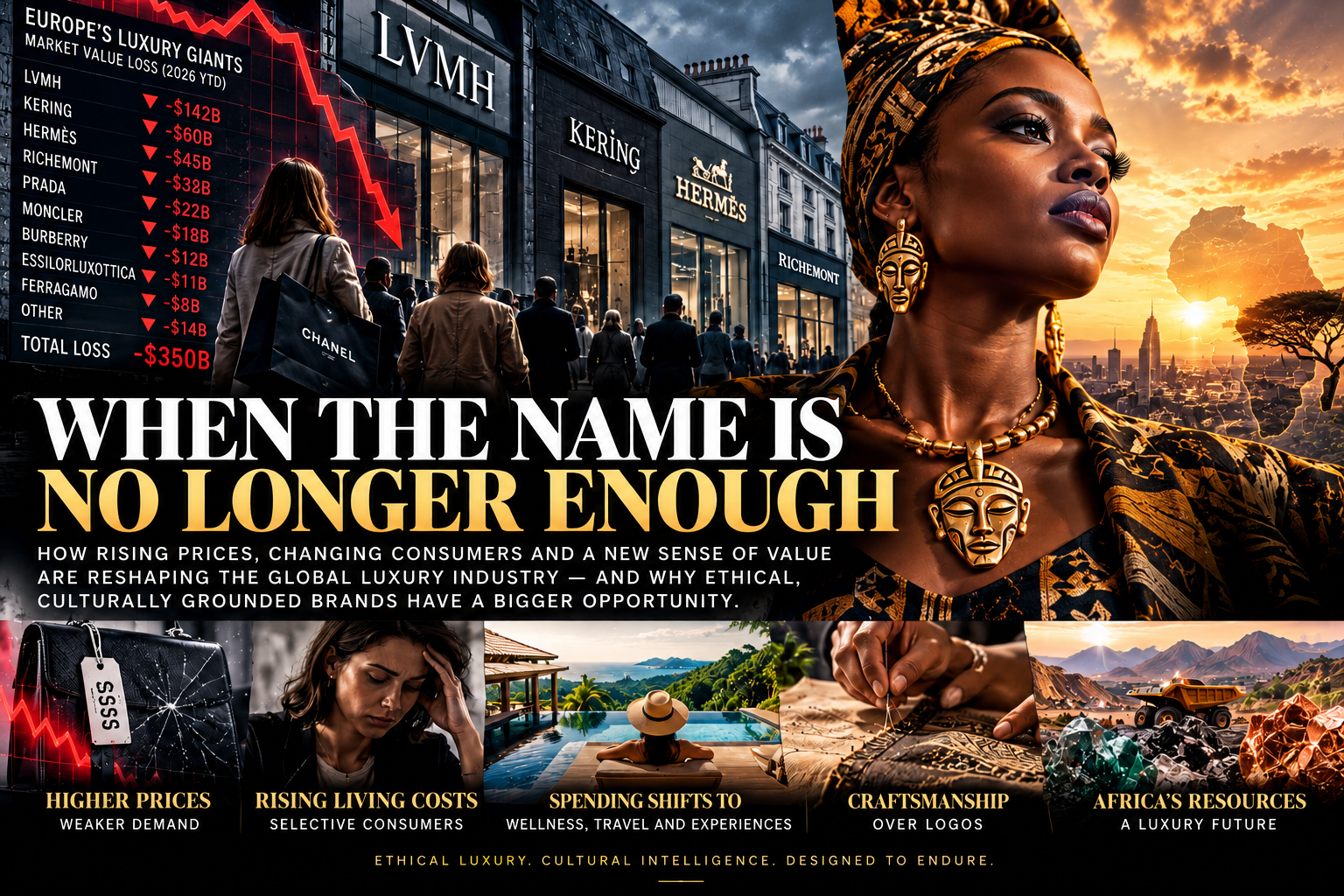
Europe’s luxury industry is entering a difficult 2026—and the deeper story is not simply about declining sales. It is about a changing definition of value.
Some of Europe’s most powerful luxury houses have experienced significant losses in market value this year, with the sector’s largest companies collectively shedding hundreds of billions of dollars. Names such as LVMH, Kering, Hermès and Richemont remain among the most influential forces in global fashion, but the market is sending a clear signal: the luxury name alone may no longer be enough.
For years, luxury depended on a powerful equation:
Prestige + scarcity + branding = value.
But today’s consumer is increasingly asking a different question:
What am I actually paying for?
The Middle-Class Luxury Consumer Is Pulling Back
One of the most important customers in global luxury has never been the ultra-wealthy consumer. It has been the aspirational and middle-class buyer—the person willing to save for a handbag, watch, jacket or pair of shoes because the purchase represents identity, achievement and belonging.
That consumer is now becoming more selective.
Higher prices, rising living costs and concerns about whether products genuinely justify their price are forcing consumers to reconsider discretionary purchases.
A luxury product that once felt like an attainable reward can begin to feel excessive when its price rises faster than its perceived quality.
And that creates a serious challenge for the industry.
When consumers sacrifice to buy luxury, they expect the object to mean something.
Luxury Is Moving Beyond the Logo
At Star and Shield Clothing, we believe this shift represents an opportunity to rethink what luxury should mean.
Luxury should not simply be the ability to charge more.
Luxury should be the ability to make something worth keeping.
That means craftsmanship.
It means cultural meaning.
It means responsible production.
It means materials that are chosen with intention.
It means knowing who made the product and understanding the story behind it.
And increasingly, it means creating garments that are not designed to become disposable after one season.
The Rise of Ethical Luxury
The next generation of luxury will be judged not only by what appears on the outside of a product, but by what happens before it reaches the customer.
Where was it made?
Who made it?
Were workers treated fairly?
What materials were used?
How long will the product last?
Does the design have cultural integrity?
Can the customer repair, preserve or pass it forward?
These questions turn luxury from a marketing category into a relationship between maker, material, culture and customer.
This is where ethical luxury becomes more than a trend.
It becomes a philosophy.
Africa Has Always Had Another Definition of Luxury
Across Africa, luxury has historically been connected to craftsmanship, symbolism, lineage, ceremony and identity.
Adornment was not simply decoration.
Textiles could communicate belonging. Jewelry could carry meaning. Patterns could preserve memory. Objects could represent status, spirituality, community and ancestry.
The modern fashion industry often separates these ideas—placing culture in one category and luxury in another.
We don’t believe they need to be separated.
At Star and Shield Clothing, our approach is rooted in the idea that African cultural intelligence can be part of contemporary luxury without being reduced to a costume or a marketing aesthetic.
The future of luxury can be technological and ancestral at the same time.
The Customer Is Spending Differently
Another important shift is happening beyond fashion.
Consumers are increasingly directing discretionary spending toward wellness, health, hospitality, travel, restaurants and experiences.
This doesn’t necessarily mean people have stopped wanting beautiful things.
It means the definition of a worthwhile purchase is changing.
People want products and experiences that contribute something to their lives.
A garment can do that too—but it has to offer more than a recognizable name.
It needs design.
It needs quality.
It needs meaning.
It needs longevity.
From Status Symbol to Cultural Asset
This is the opportunity for independent and culturally grounded brands.
A global luxury house can sell a product because millions of people recognize its logo.
An ethical luxury brand has the opportunity to create something different:
a product that becomes more meaningful because the customer understands its origin.
That is a different kind of value.
A garment can become an archive of craftsmanship.
A necklace can become a family object.
A pattern can carry cultural memory.
A carefully made piece can move from one generation to another rather than from one season to the next.
That is luxury with a longer horizon.
The New Luxury Question
The luxury industry may be entering a period where consumers are asking harder questions than ever before.
Not:
“How famous is the brand?”
But:
“Why is this worth what you’re asking me to pay?”
And perhaps even more importantly:
“What does my purchase support?”
At Star and Shield Clothing, we believe the answer should include craftsmanship, cultural integrity, responsible production and enduring design.
Because luxury should not be defined only by scarcity.
It should be defined by significance.
And in an era of rising prices, environmental pressure and increasingly conscious consumers, the most luxurious thing a brand may be able to offer is not another logo.
It may be something genuinely worth keeping.
Star and Shield Clothing
Ethical Luxury. Cultural Intelligence. Designed to Endure.
From Africa to the world, we believe the future of luxury should respect the past while building something worthy of the future.
Leave a Reply